One of the central questions in contemporary philosophy of science is whether the complex, functional order observed in biological systems is merely the outcome of blind, unguided processes or whether it may point to an underlying rationality and intentional design. The present biological study on the development of gill rakers in silver carp, while firmly situated within developmental biology and transcriptomics, offers empirical findings that naturally lend themselves to interpretation within the framework of Intelligent Design and, at a deeper level, theological reflection on God.
The first striking feature of this study is the highly coordinated genetic regulation underlying gill raker development. The authors reported more than 10,000 differentially expressed genes whose expression changes were not random but were significantly enriched in specific molecular pathways, such as focal adhesion, ECM–receptor interaction, and PI3K–Akt signalling. From a philosophical perspective, such large-scale coordination suggests a level of systemic organisation that exceeds expected, stochastic genetic fluctuations. Instead, the data reveal a tightly integrated genetic network in which individual components derive their meaning and function only within the context of the whole network. In the Intelligent Design discourse, this is often described as organised complexity—a hallmark of systems shaped by informational order rather than chance alone.
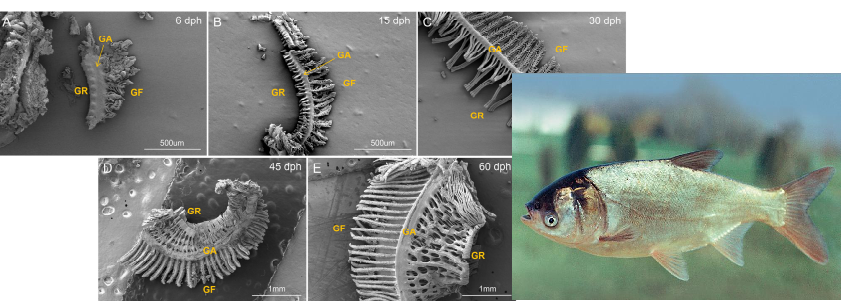
The second important observation concerns the directional transition from simple to complex functional structures. Scanning electron microscopy demonstrated that gill rakers develop from sparse, rudimentary protrusions into a dense, interlocking mesh optimised for filter feeding. Crucially, this transformation is not merely an increase in complexity but an increase in functional coherence. Each developmental stage is viable and appropriate to the organism’s dietary needs at that moment, while simultaneously preparing a structural foundation for the next stage. Such a stepwise yet goal-oriented progression aligns with what proponents of design call teleological continuity: not only is the final structure functional, but the developmental pathway itself appears to be rational and efficient.
Third, thiss study highlights the concerted action of independent gene familie, , notably collagen and integri, s, in constructing a single, unified biological structure. These gene families perform distinct roles; however,ever, their synchronized upregulation enables extracellular scaffolding, cell adhesion, and migration to occur in precise harmony. Systems in which multiple components must be present and properly coordinated to yield any functional outcome are often cited in the the Intelligent Design literature as examples of interdependent systems. Such systems challenge explanations based solely on gradual, unguided accumulation because partial or uncoordinated expression would fail to produce a functional advantage.
Fourth, there is a direct link between genes, morphology, function, and ecology. The authors explicitly state that their findings bridge the fields of developmental biology, evolutionary biology, and ecology. This statement has philosophical significance beyond its empirical content. This suggests that biological reality is not composed of disconnected layers but rather forms a coherent, multi-level unity. In natural theology, such coherence has traditionally been interpreted as a sign of an overarching rational principle or an organizing intelligence underlying natural processes.
From a theological perspective, these findings are especially compatible with the view of God not as a sporadic supernatural intervener but as the ground of order, information, and lawful regularity in nature. In this framework, God does not replace scientific explanations but makes them possible through divine action. Molecular pathways, genetic information, and self-organizing developmental processes can be understood as expressions of deeper rationality embedded in the fabric of life itself. The existence of such finely tuned systems raises the question of whether material causes alone provide a sufficient ultimate explanation.
Importantly, this interpretation does not deny the existence of evolutionary processes or empirical biology. Rather, it asks whether evolution itself may operate within a preexisting informational and rational framework. The study shows that developmental outcomes depend on the precise timing, regulation, and interaction of molecular systems—features that strongly resonate with the idea that biological life is structured by intelligible principles rather than mere contingency.
In conclusion, although this study focuses on a specific biological structure, the gill rakers of silver carp, it presents a broader picture of life as integrated, goal-directed, and information-rich. Although it does not constitute empirical proof of God, it challenges purely reductionist interpretations of biological order. At the intersection of science, philosophy, and theology, such findings invite renewed reflection on whether the most comprehensive explanation of biological complexity ultimately points beyond matter to the mind and beyond the mechanism to meaning.
