Tag: Divine Wisdom

  • Intelligent Design, Biological Order, and Theological Implications in the Development of Silver Carp Gill Rakers

    Intelligent Design, Biological Order, and Theological Implications in the Development of Silver Carp Gill Rakers

    One of the central questions in contemporary philosophy of science is whether the complex, functional order observed in biological systems is merely the outcome of blind, unguided processes or whether it may point to an underlying rationality and intentional design. The present biological study on the development of gill rakers in silver carp, while firmly situated within developmental biology and transcriptomics, offers empirical findings that naturally lend themselves to interpretation within the framework of Intelligent Design and, at a deeper level, theological reflection on God.
    The first striking feature of this study is the highly coordinated genetic regulation underlying gill raker development. The authors reported more than 10,000 differentially expressed genes whose expression changes were not random but were significantly enriched in specific molecular pathways, such as focal adhesion, ECM–receptor interaction, and PI3K–Akt signalling. From a philosophical perspective, such large-scale coordination suggests a level of systemic organisation that exceeds expected, stochastic genetic fluctuations. Instead, the data reveal a tightly integrated genetic network in which individual components derive their meaning and function only within the context of the whole network. In the Intelligent Design discourse, this is often described as organised complexity—a hallmark of systems shaped by informational order rather than chance alone.
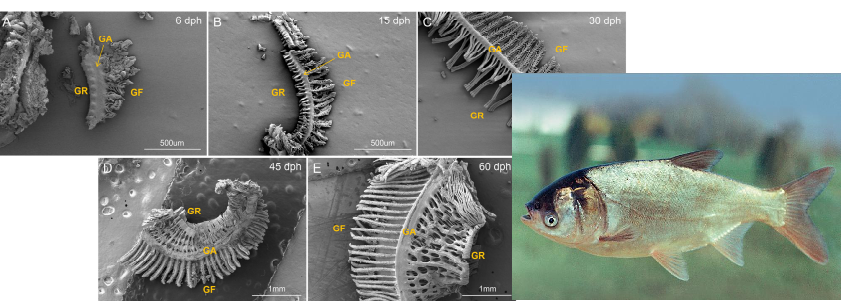
    The second important observation concerns the directional transition from simple to complex functional structures. Scanning electron microscopy demonstrated that gill rakers develop from sparse, rudimentary protrusions into a dense, interlocking mesh optimised for filter feeding. Crucially, this transformation is not merely an increase in complexity but an increase in functional coherence. Each developmental stage is viable and appropriate to the organism’s dietary needs at that moment, while simultaneously preparing a structural foundation for the next stage. Such a stepwise yet goal-oriented progression aligns with what proponents of design call teleological continuity: not only is the final structure functional, but the developmental pathway itself appears to be rational and efficient.
    Third, thiss study highlights the concerted action of independent gene familie, , notably collagen and integri, s, in constructing a single, unified biological structure. These gene families perform distinct roles; however,ever, their synchronized upregulation enables extracellular scaffolding, cell adhesion, and migration to occur in precise harmony. Systems in which multiple components must be present and properly coordinated to yield any functional outcome are often cited in the the Intelligent Design literature as examples of interdependent systems. Such systems challenge explanations based solely on gradual, unguided accumulation because partial or uncoordinated expression would fail to produce a functional advantage.
    Fourth, there is a direct link between genes, morphology, function, and ecology. The authors explicitly state that their findings bridge the fields of developmental biology, evolutionary biology, and ecology. This statement has philosophical significance beyond its empirical content. This suggests that biological reality is not composed of disconnected layers but rather forms a coherent, multi-level unity. In natural theology, such coherence has traditionally been interpreted as a sign of an overarching rational principle or an organizing intelligence underlying natural processes.
    From a theological perspective, these findings are especially compatible with the view of God not as a sporadic supernatural intervener but as the ground of order, information, and lawful regularity in nature. In this framework, God does not replace scientific explanations but makes them possible through divine action. Molecular pathways, genetic information, and self-organizing developmental processes can be understood as expressions of deeper rationality embedded in the fabric of life itself. The existence of such finely tuned systems raises the question of whether material causes alone provide a sufficient ultimate explanation.
    Importantly, this interpretation does not deny the existence of evolutionary processes or empirical biology. Rather, it asks whether evolution itself may operate within a preexisting informational and rational framework. The study shows that developmental outcomes depend on the precise timing, regulation, and interaction of molecular systems—features that strongly resonate with the idea that biological life is structured by intelligible principles rather than mere contingency.
    In conclusion, although this study focuses on a specific biological structure, the gill rakers of silver carp, it presents a broader picture of life as integrated, goal-directed, and information-rich. Although it does not constitute empirical proof of God, it challenges purely reductionist interpretations of biological order. At the intersection of science, philosophy, and theology, such findings invite renewed reflection on whether the most comprehensive explanation of biological complexity ultimately points beyond matter to the mind and beyond the mechanism to meaning.
  • The Role of Bees in Ecosystems and the Food Supply Chain

    The Role of Bees in Ecosystems and the Food Supply Chain

    Introduction

    Bees play a vital role in terrestrial ecosystems. These creatures, through pollinating flowering plants, provide a foundation for maintaining biodiversity and sustaining food supply chains. With over 16,000 known species, bees are indispensable in natural and agricultural ecosystems. This article focuses on the biological role of bees, particularly in pollination, and its impact on food supply chains and food security.

    Pollination: The Pillar of Ecosystem Life

    Pollination is the process of transferring pollen from the stamen (male part) to the pistil (female part) of flowers, essential for plant reproduction. Bees, due to their hairy body structure and reliance on nectar and pollen, are the most efficient pollinators. Over 80% of flowering plants, including wild plants and crops, depend on bee pollination. This process not only leads to seed and fruit production but also preserves plant genetic diversity and aids in their evolution.

    Role in Biodiversity

    Bees maintain biodiversity in natural ecosystems by pollinating wild plants. Approximately 70% of flowering plants rely on animal pollinators, particularly bees. Some plants, such as orchids, are pollinated exclusively by specific bee species. This interaction helps maintain the structure of ecosystems, including forests, grasslands, and wetlands. Plants pollinated by bees provide food, shelter, and habitats for other wildlife species, forming the foundation of food chains.

    Species Diversity of Bees

    The diversity of bees, from social species like the honeybee (Apis mellifera) to solitary species like carpenter bees (Xylocopa) and bumblebees (Bombus), enhances pollination efficiency. Each bee species has a unique ecological role, and another cannot replace the function of one species. For instance, bumblebees are highly effective for crops like tomatoes and blueberries through buzz pollination, while solitary bees like megachilids specialize in pollinating alfalfa.

    Role of Bees in Food Supply Chains

    Bees play a critical role in food supply chains by pollinating crops. About one-third of human food consumption, including fruits, vegetables, and nuts, depends on bee pollination. Crops such as apples, almonds, peaches, squash, coffee, and sunflowers directly benefit from bee activity.

    Food Security

    Pollination by bees not only increases the yield of crops but also improves their quality and nutritional value. For example, proper pollination can enhance the size, flavor, and nutrient content of fruits and vegetables. This contributes to providing healthy and diverse food for human communities, especially in regions with limited access to nutritious foods. In India, 80% of crops depend on or benefit from insect pollination, primarily by bees.

    Impact on Food Chains

    Plants pollinated by bees, whether wild or agricultural, form the basis of food chains. These plants provide food for herbivores, which in turn are prey for predators and other creatures. Without bees, a decline in seed and fruit production could lead to the collapse of food chains, as many animal species depend on these plants. For example, reduced pollination of wild plants could limit food resources for birds and small mammals, disrupting ecosystem balance.

    Ecological Roles Beyond Pollination

    In addition to pollination, bees have other biological roles:

    • Specialized Herbivory: By feeding on nectar and pollen, bees, as specialized herbivores, help regulate plant populations.
    • Prey in Food Chains: Bees serve as food for birds, reptiles, amphibians, and other insects, contributing to food web balance.
    • Microorganism Dispersal: Bees transfer fungal spores and microbes, aiding nutrient cycling and microbial diversity.
    • Nutrient Recycling: Bee waste returns nutrients like nitrogen and phosphorus to the soil, enhancing ecosystem fertility.

    Where Does Theology Fit into This Discussion?

    It must first be noted that humans are so fragile that if bees and other pollinating creatures were removed from Earth, plants would perish due to lack of pollination, leading to famine and the extinction of humans and other creatures. This illustrates that humans are not in a position to defy the Creator of the universe, as the design of creation is so intricate yet delicate that, if God wills, life on Earth can be sustained or ended through a single bee.

    Imagine, hypothetically, if this world had no Creator and, as atheists claim, the Earth and universe were the result of chance. In the absence of a Creator, if plants existed but bees and other pollinating insects did not emerge by chance, what would happen? Plants could not pollinate or spread, resulting in no vegetation cover. Humans and other creatures would have no food, and we would not exist. However, because bees and other insects exist, it indicates that this world has a powerful Creator who has meticulously arranged all the necessary pieces, even a tiny bee, like a puzzle to enable human existence on Earth. If the world had no Creator, one piece of this puzzle, such as a bee or butterfly responsible for pollination and plant reproduction, would likely not have emerged by chance, and we would not exist.

    In Surah An-Nahl, God Almighty states:

    And your Lord revealed to the bee saying: Make hives in the mountains and in the trees and in what they build: (68)-Then eat of all the fruits and walk in the ways of your Lord submissively. There comes forth from within it a beverage of many colours, in which there is healing for men; most surely there is a sign in this for a people who reflect (69)