Tag: Science and Religion

  • Intelligent Design, Biological Order, and Theological Implications in the Development of Silver Carp Gill Rakers

    Intelligent Design, Biological Order, and Theological Implications in the Development of Silver Carp Gill Rakers

    One of the central questions in contemporary philosophy of science is whether the complex, functional order observed in biological systems is merely the outcome of blind, unguided processes or whether it may point to an underlying rationality and intentional design. The present biological study on the development of gill rakers in silver carp, while firmly situated within developmental biology and transcriptomics, offers empirical findings that naturally lend themselves to interpretation within the framework of Intelligent Design and, at a deeper level, theological reflection on God.
    The first striking feature of this study is the highly coordinated genetic regulation underlying gill raker development. The authors reported more than 10,000 differentially expressed genes whose expression changes were not random but were significantly enriched in specific molecular pathways, such as focal adhesion, ECM–receptor interaction, and PI3K–Akt signalling. From a philosophical perspective, such large-scale coordination suggests a level of systemic organisation that exceeds expected, stochastic genetic fluctuations. Instead, the data reveal a tightly integrated genetic network in which individual components derive their meaning and function only within the context of the whole network. In the Intelligent Design discourse, this is often described as organised complexity—a hallmark of systems shaped by informational order rather than chance alone.
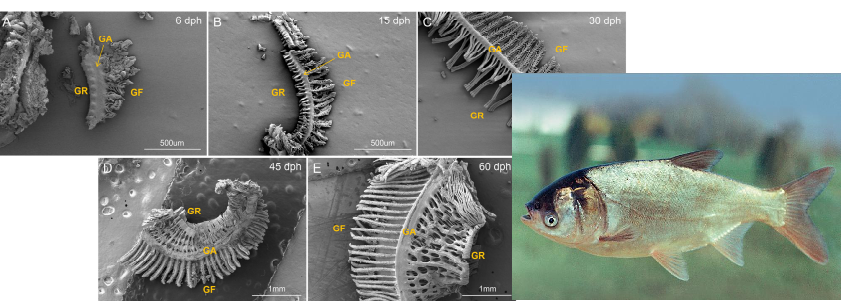
    The second important observation concerns the directional transition from simple to complex functional structures. Scanning electron microscopy demonstrated that gill rakers develop from sparse, rudimentary protrusions into a dense, interlocking mesh optimised for filter feeding. Crucially, this transformation is not merely an increase in complexity but an increase in functional coherence. Each developmental stage is viable and appropriate to the organism’s dietary needs at that moment, while simultaneously preparing a structural foundation for the next stage. Such a stepwise yet goal-oriented progression aligns with what proponents of design call teleological continuity: not only is the final structure functional, but the developmental pathway itself appears to be rational and efficient.
    Third, thiss study highlights the concerted action of independent gene familie, , notably collagen and integri, s, in constructing a single, unified biological structure. These gene families perform distinct roles; however,ever, their synchronized upregulation enables extracellular scaffolding, cell adhesion, and migration to occur in precise harmony. Systems in which multiple components must be present and properly coordinated to yield any functional outcome are often cited in the the Intelligent Design literature as examples of interdependent systems. Such systems challenge explanations based solely on gradual, unguided accumulation because partial or uncoordinated expression would fail to produce a functional advantage.
    Fourth, there is a direct link between genes, morphology, function, and ecology. The authors explicitly state that their findings bridge the fields of developmental biology, evolutionary biology, and ecology. This statement has philosophical significance beyond its empirical content. This suggests that biological reality is not composed of disconnected layers but rather forms a coherent, multi-level unity. In natural theology, such coherence has traditionally been interpreted as a sign of an overarching rational principle or an organizing intelligence underlying natural processes.
    From a theological perspective, these findings are especially compatible with the view of God not as a sporadic supernatural intervener but as the ground of order, information, and lawful regularity in nature. In this framework, God does not replace scientific explanations but makes them possible through divine action. Molecular pathways, genetic information, and self-organizing developmental processes can be understood as expressions of deeper rationality embedded in the fabric of life itself. The existence of such finely tuned systems raises the question of whether material causes alone provide a sufficient ultimate explanation.
    Importantly, this interpretation does not deny the existence of evolutionary processes or empirical biology. Rather, it asks whether evolution itself may operate within a preexisting informational and rational framework. The study shows that developmental outcomes depend on the precise timing, regulation, and interaction of molecular systems—features that strongly resonate with the idea that biological life is structured by intelligible principles rather than mere contingency.
    In conclusion, although this study focuses on a specific biological structure, the gill rakers of silver carp, it presents a broader picture of life as integrated, goal-directed, and information-rich. Although it does not constitute empirical proof of God, it challenges purely reductionist interpretations of biological order. At the intersection of science, philosophy, and theology, such findings invite renewed reflection on whether the most comprehensive explanation of biological complexity ultimately points beyond matter to the mind and beyond the mechanism to meaning.
  • The Secrets of the Cosmos: From a Septillion Stars to Humanity’s Place in the Universe

    The Secrets of the Cosmos: From a Septillion Stars to Humanity’s Place in the Universe

    Our Sun is just one of about 100 billion stars in the Milky Way galaxy. This galaxy, in all its glory, is only one of nearly two trillion known galaxies in the universe. Let’s estimate the number of stars across the entire cosmos. In that case, we encounter a staggering figure: a septillion stars — that is, 10²⁴ stars, or a million billion billion stars. These numbers are so vast that they are difficult for the human mind to comprehend, but grasping their magnitude brings us closer to understanding the true immensity of the universe.

    Each star is a massive ball of burning gas (mainly hydrogen) held together by gravity and producing energy through nuclear fusion. Stars vary greatly in size, mass, and temperature. Some, like red dwarfs, are small and consume fuel slowly, allowing them to shine for over a trillion years. On the other end are stars like UY Scuti, with a diameter over 1,700 times that of the Sun, which live for only a few million years before ending in massive supernova explosions. Our Sun, with an estimated lifespan of about 10 billion years, is somewhere in the middle and has now lived about half its life.

    In each galaxy, there are billions of planetary systems. In the Milky Way alone, there are likely more than 100 billion planets, and evidence suggests that many may lie in habitable zones — regions that might have conditions similar to Earth. In other words, even within our galaxy, there could be billions of potentially life-supporting planets. If we extend this possibility to the entire universe, the existence of life in far-off corners of the cosmos becomes not only possible but even likely.

    Yet, what we observe is not the whole reality. Most of the mass of the universe consists of something unobservable: dark matter and dark energy. Dark matter, which comprises about 85% of the universe’s mass, is detected only through its gravitational effects on galaxies. Alongside it, dark energy, which makes up about 70% of the universe’s energy content, is believed to be responsible for the accelerated expansion of the cosmos. Furthermore, billions of black holes are hidden at the centers of galaxies — including a supermassive black hole at the heart of the Milky Way, with a mass millions of times that of the Sun.

    The age of the universe is estimated to be around 13.8 billion years. The light we see today from the most distant galaxies has been traveling for billions of years, and what we observe is a glimpse into the distant past. On this cosmic scale, our Earth — this tiny blue dot — is merely a speck in a vast ocean of darkness and light. Our Sun is one of a septillion stars to which we happen to be near. Still, as we gaze at the sky, we are looking at signs of billions of other suns — each with a unique story, perhaps with planets, perhaps with life, and perhaps with mysteries we have yet to comprehend.

    Theological Reflection

    Amidst all this, there is a foundational point in theology: the smaller and simpler the universe, the more plausible its emergence by chance might seem. But the creation of a universe with such vastness and intricate order renders the idea of randomness highly implausible and unacceptable. Thus, the larger and more complex the universe is, the closer the likelihood of its chance emergence approaches zero.

    In response to atheists who use the vastness of the universe to deny the existence of a Creator, one might say that if the universe were smaller, they would use that as a reason to claim it was random. Now that it is grand and vast, they claim humanity’s existence in it is an accident! This is a form of evading the truth. Yet, from the perspective of an insightful mind, the magnitude of the universe is itself a clear sign of the greatness of its Creator — a Creator who has displayed His infinite power across the cosmos and has brought forth such an astonishing order. Therefore, the immensity of the universe is not a reason to reject God but an apparent reason to recognize His power and knowledge.

    For better understanding, consider an analogy from the world of technology: writing a simple piece of code by stringing together a few characters is something even a novice student can do. But can Google — with billions of lines of code — be considered the product of chance? Such a project is only possible through the tireless efforts of thousands of engineers and intelligent design. Then how can we possibly believe the universe, which functions with far greater order than Google, is the result of randomness? The difference here is that the Creator of the universe, unlike any human-made project, needs no collaborators and is not bound by time or space. He is one, omnipotent, and the universe is a flawless display of His power.

    In this regard, the Holy Quran also draws our attention to the signs in the sky. In Surah Al-Waqi’ah, verses 75 and 76, it says:

    “Then I swear by the positions of the stars — and indeed, it is a mighty oath if you only knew.”

    This verse presents the positions of the stars as a great sign — a sign for those who reflect and seek the greatness of the Creator in the fabric of creation.